Vivo hasn’t announced anything officially. But the leaks keep coming, and at this point, the picture is clear enough to be worth paying attention to.
The Vivo X500 series is shaping up to be one of the more ambitious flagship lineups the company has attempted. Multiple tips from trusted sources, including Weibo-based leaker Digital Chat Station, point to a lineup that pushes battery capacity further than almost any mainstream Android phone right now, pairs it with a 200MP periscope telephoto on the top model, and brings a 2nm chipset from MediaTek that hasn’t launched yet.
Here’s what’s been leaked, what it means in practice, and which model makes sense for different buyers.
Quick answer: The Vivo X500 series is expected to launch in China in September 2026, with a global rollout in November or December. The standard X500 is tipped to carry a 7,500mAh battery and a 64MP periscope camera, while the Pro Max is expected to go further with an 8,000mAh battery, a 200MP periscope telephoto, and a larger 2K display. Neither model has been officially confirmed by Vivo.
Vivo X500 vs Vivo X500 Pro Max: Specs Compared
| Feature | Vivo X500 | Vivo X500 Pro Max |
| Display | 6.59-inch OLED | 6.85-inch 2K LTPO OLED (BOE) |
| Refresh Rate | Up to 144Hz | Up to 144Hz |
| Processor | MediaTek Dimensity 9600 (2nm) | MediaTek Dimensity 9600 Pro (2nm) |
| RAM | LPDDR6 | LPDDR6 |
| Battery | ~7,500mAh | ~8,000mAh (not finalised) |
| Charging | 100W fast charging | 100W+ fast charging |
| Main Camera | 50MP Sony LOFIC (1/1.28-inch) | 50MP Sony LYT-838 LOFIC (1/1.28-inch) |
| Ultra-wide | 50MP | 50MP |
| Telephoto | 64MP periscope | 200MP periscope (1/1.4-inch, 85mm) |
| Video | 8K | 8K |
| Fingerprint | In-display ultrasonic | In-display ultrasonic |
| Expected Price (India) | To be confirmed | To be confirmed |
| Launch (China) | September 2026 | September 2026 |
All specifications are based on leaks. Nothing has been officially confirmed by Vivo.
(Sources: Memeburn — https://memeburn.com/vivo-x500-series-leaks-what-to-expect/ | My Mobile India — https://www.mymobileindia.com/vivo-x500e-tipped-with-snapdragon-8-series-chip-and-zeiss-cameras-x500-pro-max-leak-reveals-lpddr6-ram-and-8000mah-class-battery/ | TimesBull — https://www.timesbull.com/vivo-x500-pro-max-leak-with-200mp-periscope-camera-8000mah-battery)
The Battery Story And Why the Numbers Are Impressive
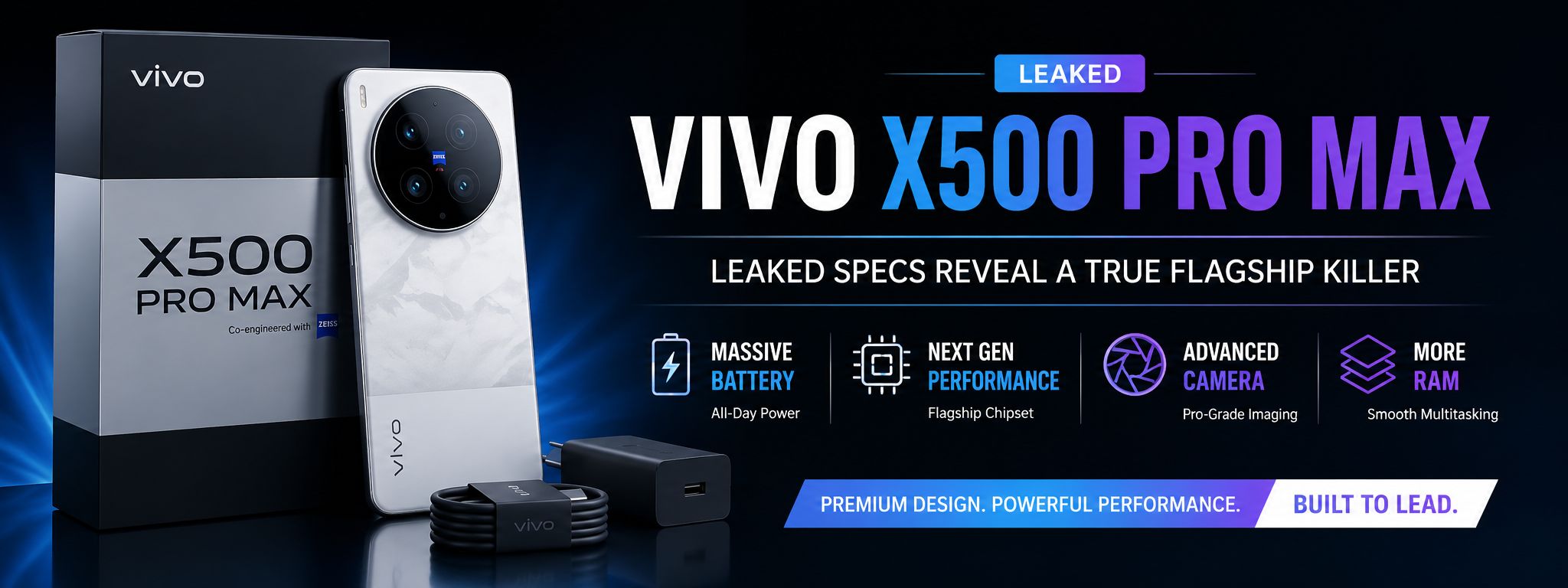
The X300’s predecessor was the X2, which had a 6,040mAh battery. With the X300 Pro, it climbed to 6,510mAh. The standard model leaps to 7,500mAh and the Pro Max tips 8,000mAh if the X500 leaks are legitimate. That is a huge change and one generation apart.
How is this achievable without turning the phone into a brick? Silicon-carbon battery technology. Graphite anodes continue to be the predominant choice in lithium-ion cells of mainstream phones. That is instead replaced by a silicon-carbon composite capable of holding more lithium ions in the same physical volume, with higher energy density without needing a physically larger cell to do it.
OPPO, OnePlus, and Xiaomi have all moved in this direction in 2026. Vivo appears to be following the same path.
One thing to be honest about: Digital Chat Station said the Pro Max battery would “start with an 8”, not that it’s definitely 8,000mAh. The design hasn’t been finalised yet. The final number could be 8,000, or it could be 8,200, or something slightly lower. We’ll know when Vivo confirms.
What’s worth noting is the weight question. Bigger battery cells add grams. Whether Vivo can keep the Pro Max under 230g while fitting an 8,000mAh silicon-carbon cell is something the leaks haven’t addressed yet.
The 200MP Telephoto, What’s Actually Different
A 200MP sensor sounds impressive on a spec sheet. But the more useful question is: what does it change in real-world shooting?
The leaked 200MP periscope telephoto on the Pro Max uses a 1/1.4-inch sensor at 85mm focal length, with support for telephoto macro photography. That sensor size is large for a telephoto; most flagship periscope cameras use smaller sensors to fit inside the phone’s body. A bigger sensor means more light captured, better low-light telephoto performance, and cleaner detail when you zoom in hard.
The 200MP resolution itself is mainly useful for two things: cropping dramatically after the shot while retaining detail, and pixel-binning to produce very high-quality lower-resolution images in varying light conditions. It’s not about printing massive posters. It’s about flexibility.
The standard X500’s 64MP periscope is nothing to dismiss either. It uses the Sony IMX06H sensor, a newer Sony unit that My Mobile India says is built for improved 3x zoom performance. But the 200MP exclusive to the Pro Max is clearly the headline imaging feature of the lineup.
How does it stack up against the competition?
- The Samsung Galaxy S26 Ultra is expected to have an upgraded 200MP main sensor system.
- The Xiaomi 16 Ultra already runs a triple-camera setup including a high-resolution periscope.
- Apple’s iPhone 17 Pro Max doesn’t chase megapixels the same way but leads in video processing.
On raw camera specs on paper, the Pro Max is competitive. Whether Vivo’s image processing software matches Apple’s or Samsung’s tuning is a separate question, and that’s where leaks can’t tell you much.
Why Vivo Skipped the X400 Name
You might wonder why the series jumped from X300 directly to X500.
This comes down to tetraphobia, a cultural aversion to the number four that’s common in several East Asian countries, including China. In Mandarin, Cantonese, Japanese, and Korean, the word for “four” sounds similar to the word for “death.” Many buildings in China skip the 4th floor entirely. Tech companies, including Vivo, often avoid product names or model numbers containing the digit 4.
Vivo isn’t alone in this. Samsung’s Galaxy Note series jumped from Note 3 to Note 5 in certain Asian markets. OnePlus similarly skipped the OnePlus 4 in China, releasing the OnePlus 5 as the follow-up to the 3T.
It’s a market-specific naming decision that has nothing to do with the phone’s development cycle. The X500 is effectively the X400 in everything but name.
LTPO vs Standard OLED: What’s the Actual Difference?
The Pro Max is expected to use an LTPO OLED panel. The standard X500 may use a regular OLED.
LTPO stands for Low-Temperature Polycrystalline Oxide. The key practical difference: an LTPO panel can vary its refresh rate dynamically, dropping to as low as 1Hz when the screen is showing a static image (like a clock face), then jumping back to 120Hz or 144Hz during fast scrolling or gaming. This saves meaningful battery life compared to a panel locked to a fixed high refresh rate.
For a phone with an 8,000mAh battery, the LTPO advantage matters less in absolute terms. But it still adds to overall efficiency. And the Pro Max’s 2K resolution on a 6.85-inch screen looks noticeably sharper than a 1080p or 1.5K panel at that screen size.
The Dimensity 9600 Pro: What It Actually Does
MediaTek’s Dimensity 9600 Pro is a 2nm chip that hasn’t publicly launched yet. Based on what’s been reported:
- Built on TSMC’s 2nm process (same node as Apple’s A18 Pro)
- Improved CPU and GPU compared to the 9400
- Enhanced AI processing for on-device tasks
- Better thermal efficiency than the previous generation
Whether it matches Qualcomm’s Snapdragon 8 Elite Gen 2 or Apple’s A18 Pro in pure benchmark performance is still unknown. What 2nm typically brings: better power efficiency at equivalent performance. That means less heat, better sustained performance during long gaming sessions, and longer battery life per charge, which matters a lot on a phone already packing 7,500 to 8,000mAh.
Which Model Should You Wait For?
Go with the standard Vivo X500 if:
- You want the same basic platform in a more compact 6.59-inch body
- 7,500mAh is already more battery than you’ll ever need
- The 64MP periscope telephoto covers your zoom requirements
- You want flagship specs without crossing into ultra-premium pricing
Go with the Vivo X500 Pro Max if:
- Battery life is genuinely your top concern
- You want the best possible zoom camera in the lineup
- The 2K LTPO display on a larger screen matters to you
- You’re willing to pay a premium for the best specs in the series
FAQs
When will the Vivo X500 series launch? Based on current leaks, the X500 lineup is expected to debut in China in September 2026. A global rollout, including India, is expected in November or December 2026. Vivo has not officially confirmed the launch date.
What’s the difference between LTPO and regular OLED? LTPO panels can dynamically vary their refresh rate from 1Hz to 144Hz based on what’s on screen. A standard OLED runs at a fixed refresh rate or switches between two fixed modes. LTPO typically saves battery life during low-activity screen states.
Why did Vivo skip the X400 name? Tetraphobia — a cultural avoidance of the number four common in China and parts of East Asia, where the word for “four” sounds similar to the word for “death.” Vivo isn’t alone; several tech brands skip model numbers containing 4 in Chinese markets.
How does the Pro Max compare with Samsung Galaxy S26 Ultra? On paper, the 200MP telephoto and 8,000mAh battery are competitive with what Samsung is expected to bring in the S26 Ultra. The real differentiator will be camera software and image processing tuning — an area where Samsung has consistently held an edge. Final comparison has to wait for actual reviews.
Bottom Line
If leaks hold, the Vivo X500 series will push batteries and zoom cameras further than most flagships have gone in 2026. The Pro Max, in particular, looks like a direct challenge to Samsung’s Ultra positioning, on spec, at least.
The honest caveat is that everything here comes from prototype testing and early supply chain tips. Specs change. Chipsets get swapped. Prices come in differently than expected.
But September isn’t far. We’ll know soon enough.
Which Vivo X500 model are you most interested in? Drop it in the comments.