When Prime Minister Narendra Modi’s aircraft touched down at Halim Perdanakusuma Air Base in Jakarta on July 6, it was escorted in by Indonesian Air Force fighter jets. That kind of welcome is reserved for visits that matter. By the time bilateral talks concluded on July 7, India and Indonesia had signed 20 Memorandums of Understanding and finalised deals that cover supersonic missiles, port development, critical minerals, education, and even voting machines.
Here’s what happened, and why it matters.
A Grand Welcome of PM Modi
Indonesian President Prabowo Subianto personally received Modi at the Istana Merdeka, Jakarta’s presidential palace, with horse-mounted guards, a ceremonial Guard of Honour, and traditional cultural performances. The two leaders embraced warmly before walking into bilateral talks.
By the end of the day, Prabowo had conferred upon Modi the Bintang Adipurna of the Republic of Indonesia, the country’s highest civilian honour. It was a public signal of how seriously Jakarta values this partnership right now.
The Defence Deals: BrahMos, Astra, and Sabang Port
These are the headlines, and they’re significant.
BrahMos missiles: India and Indonesia entered an agreement for the procurement of more BrahMos missiles for Indonesia. Indonesia was already the first export buyer of BrahMos when the country signed a deal in 2022. With the new agreement, Indonesia strengthens its commitment to military cooperation with India.
Astra Mk-1 missiles: After Operation Sindoor, in which the Astra missile performed successfully in live conditions, Indonesia is importing the Astra beyond-visual-range missile developed by India. This makes Indonesia one of the first countries to buy the missile from India.
Sabang Port: The two countries signed an agreement to develop Sabang Port in Aceh, which is located in the northern tip of Sumatra. This part of Indonesia is of high strategic significance because Sabang is located at the crossing point of the Strait of Malacca, where more than 40% of the world’s trade passes through.
(Sources: ThePrint — https://theprint.in/defence/brahmos-astra-missiles-critical-minerals-sabang-port-india-indonesia-seal-key-strategic-pacts/2979481/ | New Kerala — https://www.newkerala.com/news/a/india-indonesia-sign-key-pacts-brahmos-missile-supply-303.htm)
Critical Minerals: Pushing Back Against China’s Dominance
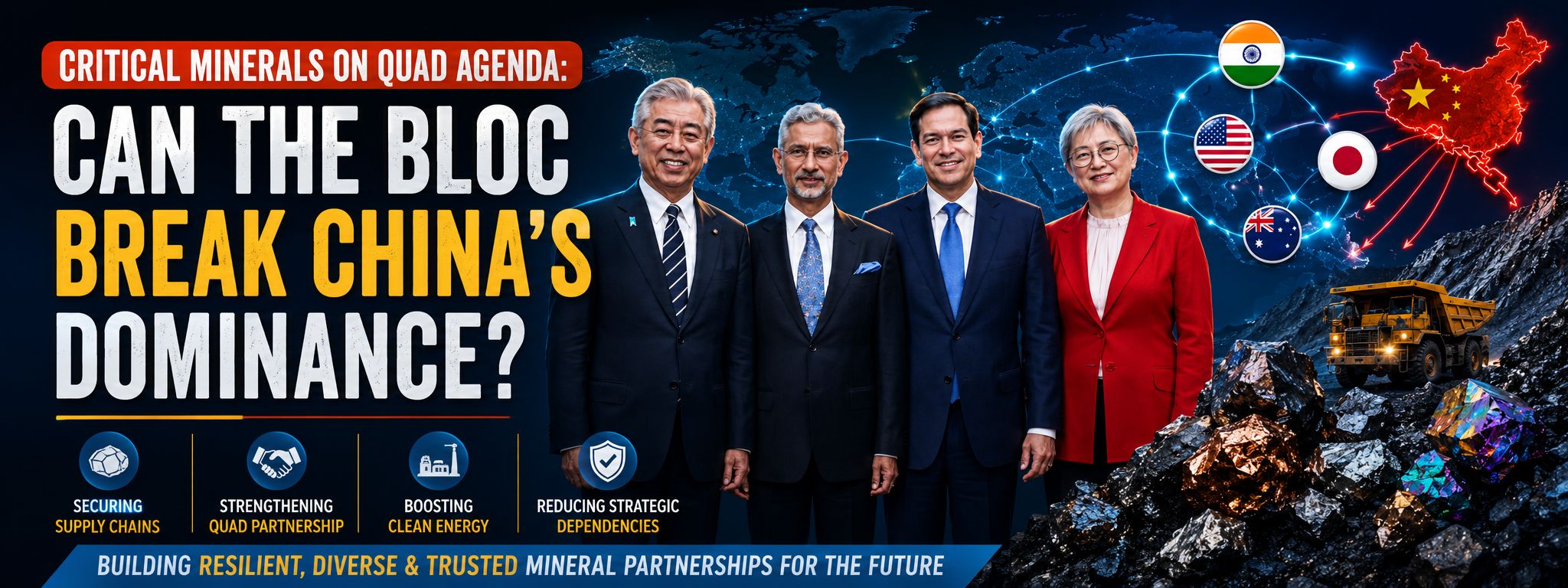
Among several significant agreements, one that does not receive the needed attention relates to critical minerals.
India will be investing in the production of steel, nickel, and rare-earth permanent magnets in Indonesia. The significance of this investment stems from the fact that China currently dominates the processing of both rare-earth elements and nickel, which are crucial materials used in the manufacture of electric vehicle batteries, semiconductors, and in the defence sector. Indonesia has the largest nickel reserves in the world, and India’s stake in this sector will challenge China’s role directly.
The opportunity has both economic and strategic dimensions in the agreement. At the same time, this would create the effect of bringing capital investment into industries where the Raw materials are available.
Why Indonesia Matters to India’s Indo-Pacific Strategy
Indonesia is more than just an option for bilateral ties. It is an essential partner.
Home to 280 million people and one of the fastest-growing economies, Indonesia is Southeast Asia’s largest country and a key voice within ASEAN. Because it has both the Malacca and the Lombok Straits, it is located strategically at two of Asia’s main maritime chokepoints. A country that wants to play a prominent role in the Indo-Pacific has to engage with Indonesia.
For India, Indonesia is an integral part of the Act East Policy, which is India’s blueprint of engagement with Southeast Asia and the Indo-Pacific.
Another Indian initiative – the MAHASAGAR Vision, which aims to strengthen maritime cooperation in the Indian Ocean – positions Indonesia as part of India’s maritime ambitions. The agreement for developing the Sabang Port is a practical reflection of this vision.
The timing matters too. As China’s presence in the South China Sea grows and as regional countries look for alternatives to over-reliance on Beijing for trade, defence, and investment, India’s deepening engagement with Jakarta sends a clear message about where India sees its future in Asia.
Complete List of Key Outcomes
| Area | Agreement |
| Defence | BrahMos missile additional procurement |
| Defence | Astra Mk-1 air-to-air missile supply |
| Maritime | Sabang Port joint development |
| Maritime | Maritime safety and security framework |
| Critical Minerals | Investment in steel, nickel, rare-earth magnets |
| Education | IIM Bangalore campus at Singhasari SEZ |
| Digital | AI, telecom, digital public infrastructure |
| Election Technology | Indonesia-specific EVM development support |
| Healthcare | Medicine supply and healthcare worker capacity building |
| Cultural | Prambanan Temple restoration agreement |
| Honour | Bintang Adipurna conferred on PM Modi |
Total MoUs signed: 20 (as confirmed by MEA)
Modi’s Three-Nation Tour: What Comes Next
Indonesia is the first stop. After concluding his visit on July 8, Modi travels to:
- Australia — where India eyes uranium supply deals and deeper defence cooperation, per ThePrint’s reporting
- New Zealand — completing the Pacific leg of the tour
The Indonesia stop is widely seen as the most strategically dense of the three, given the defence agreements and the Sabang Port deal. Australia and New Zealand discussions are expected to focus on trade, climate, and bilateral economic ties.
Bottom Line
Twenty agreements in one visit. Missiles, a strategic port near the Strait of Malacca, critical mineral investments designed to counter China’s supply chain dominance, India’s first overseas IIM campus, and the export of India’s EVM technology. Indonesia gave Modi its highest civilian honour in return.
This wasn’t a courtesy visit. It was a substantive strategic conversation between two large democracies that increasingly need each other.
Updates will be added after Modi’s Prambanan Temple visit on July 8 and the final MEA readout.
(Sources: India TV News Live Blog —