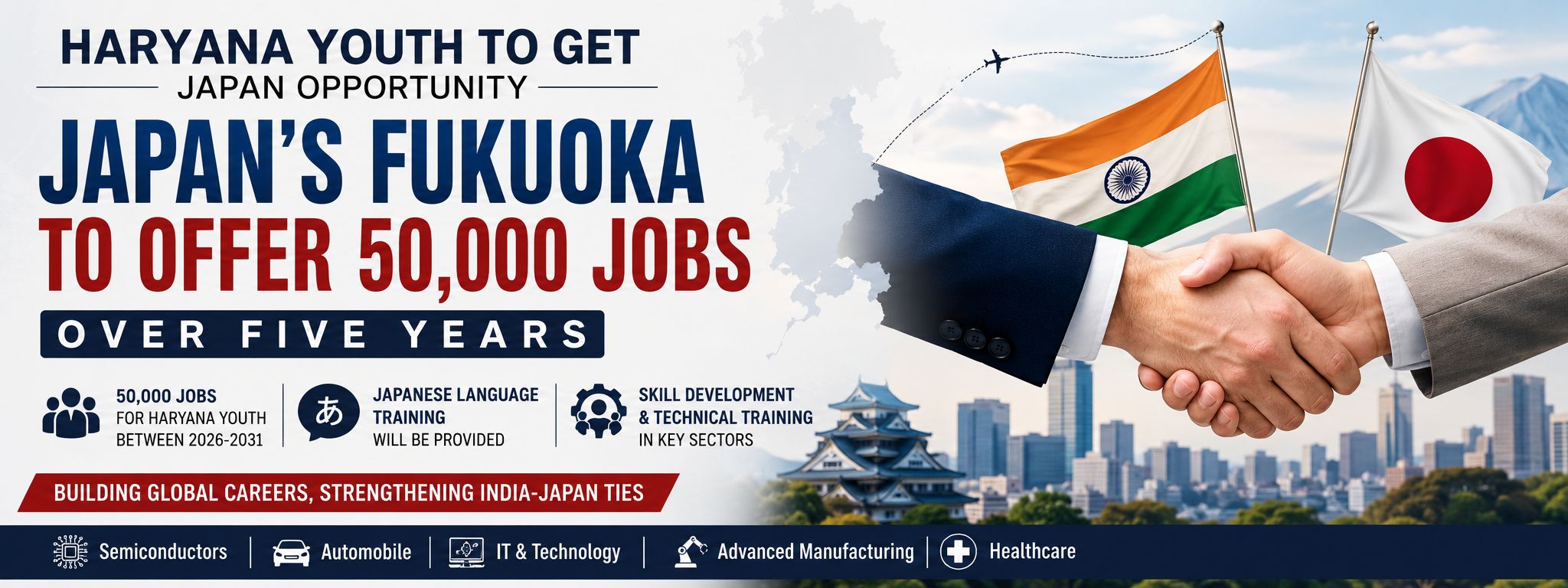
Japan is facing a growing shortage of skilled workers, and Haryana could help fill that gap. In a major employment initiative, Japan’s Fukuoka Prefecture has partnered with the Haryana government to create job and internship opportunities for 50,000 young professionals over the next five years.
The initiative, called Haryana-Fukuoka Connect 2026, aims to prepare candidates for careers in Japan through technical education, Japanese language training, and industry-focused skill development. Besides opening overseas employment opportunities, the partnership also strengthens economic and educational ties between Haryana and Japan.
Quick Answer
Under the Haryana-Fukuoka Connect 2026 initiative, Fukuoka Prefecture plans to recruit 50,000 skilled professionals from Haryana between 2026 and 2031. The partnership targets industries such as semiconductors, automobiles, IT, advanced manufacturing, and healthcare. Meanwhile, Haryana will introduce Japanese language courses and technical training through universities, ITIs, and polytechnic institutes. The Haryana Kaushal Rozgar Nigam (HKRN) will coordinate the recruitment process.
What Is Haryana-Fukuoka Connect 2026?
Officials from Fukuoka Prefecture met Haryana government representatives in Chandigarh on June 29, 2026, to launch the Haryana-Fukuoka Connect 2026 programme. During the meeting, both sides agreed to create a structured pathway that connects skilled youth from Haryana with employers in Japan.
Unlike a traditional recruitment drive, this initiative focuses on long-term workforce development. Therefore, students and professionals will receive industry-specific training before applying for jobs or internships in Japan.
The agreement also builds on Haryana’s long-standing relationship with Japanese businesses. Today, the state hosts nearly 394 Japanese companies and more than 600 Japanese business establishments, including major manufacturers such as Suzuki, Honda, and Denso.
Previously, Japanese companies invested heavily in Haryana by setting up manufacturing plants. Now, the partnership moves in the opposite direction by creating employment opportunities for Haryana’s skilled workforce in Japan.
Which Industries Need Workers?
Fukuoka’s industries continue to face severe labour shortages, particularly in technical sectors. According to officials, nearly 80% of companies in the prefecture struggle to hire enough skilled employees.
As a result, the initiative will primarily recruit professionals for the following sectors:
- Semiconductors – chip manufacturing, testing, and technical support
- Automobile Industry – production, assembly, maintenance, and quality control
- Information Technology – software support, systems management, and digital services
- Advanced Manufacturing – robotics, automation, and precision engineering
- Healthcare – selected technical and healthcare-related positions
These industries require both technical expertise and basic Japanese communication skills. Consequently, language training has become a key part of the programme.
Who Can Apply?
Although the Haryana government has not yet announced the official application process, the initiative is expected to target technically qualified candidates from across the state.
Likely beneficiaries include:
- ITI graduates with certified technical trades
- Polytechnic diploma holders
- Engineering students and graduates
- Skilled professionals in manufacturing and automobile industries
- Electronics and semiconductor technicians
- IT professionals
- Healthcare workers, subject to future recruitment requirements
Rather than relying on private job portals, the government plans to identify eligible applicants through universities, ITIs, polytechnic institutes, and the Haryana Kaushal Rozgar Nigam (HKRN).
This structured approach will help employers recruit candidates with verified qualifications while giving young professionals access to international career opportunities.
Japanese Language and Skill Training
Language will play a crucial role in the success of this initiative. Since most workplaces in Japan operate primarily in Japanese, Haryana plans to introduce structured language courses across universities, ITIs, and technical institutes.
Students will learn conversational Japanese, workplace communication, and industry-specific terminology used in manufacturing, IT, and engineering. In addition, educational institutions will strengthen technical training by updating courses in semiconductor manufacturing, robotics, automation, quality control, industrial safety, and automobile technology.
The Fukuoka Institute of Technology will also support the programme. Moreover, officials have discussed the possibility of expanding academic cooperation to strengthen long-term skill development between the two regions.
Why Japan Chose Haryana
Japan’s ageing population and declining birth rate have created a serious shortage of skilled workers. Every year, more employees retire while fewer young people enter the workforce. As a result, industries such as manufacturing, technology, and healthcare continue to face hiring challenges.
Haryana, on the other hand, produces thousands of engineering graduates, diploma holders, and ITI-certified professionals every year. Furthermore, the state already has decades of experience working with Japanese companies through industrial hubs in Gurugram, Manesar, and Bawal.
This existing relationship made Haryana a natural partner for Fukuoka’s workforce initiative. Instead of hiring workers individually, the prefecture will now recruit through a structured government-backed programme.
How Will Recruitment Work?
The Haryana Kaushal Rozgar Nigam (HKRN) will coordinate the recruitment process in partnership with the state’s Foreign Cooperation Department.
Although authorities have not announced application dates yet, officials are expected to identify eligible candidates through government universities, ITIs, and technical institutions. After completing language and technical training, shortlisted applicants will connect with Japanese employers for interviews and placement.
The government will release detailed eligibility criteria, application procedures, and timelines in the coming months. Therefore, interested candidates should regularly monitor official announcements from HKRN and the Haryana government.
What Could This Mean for Haryana Youth?
The initiative offers much more than overseas employment. It gives young professionals an opportunity to gain international work experience, improve technical skills, and build careers in one of the world’s leading industrial economies.
In addition, exposure to Japanese manufacturing practices could help participants develop expertise in advanced technologies such as semiconductors, automation, robotics, and precision engineering. Those skills may also create better career opportunities when they return to India.
Although officials have not announced salary packages under this programme, technical professionals in Japan generally earn significantly higher wages than similar entry-level positions in India. However, actual salaries will depend on the employer, industry, experience, and job role.
Frequently Asked Questions
Who can apply for the programme?
The initiative is expected to target ITI graduates, diploma holders, engineering graduates, skilled technicians, IT professionals, and other technically qualified candidates from Haryana.
Which industries are hiring?
The partnership focuses on semiconductors, automobile manufacturing, information technology, advanced manufacturing, and healthcare.
Will candidates receive Japanese language training?
Yes. Haryana plans to introduce Japanese language courses along with industry-specific communication and technical skill development before deployment.
When will applications begin?
The government has not announced an official application schedule yet. Candidates should follow updates from HKRN and the Haryana government for future notifications.
Bottom Line
The Haryana-Fukuoka Connect 2026 initiative marks a significant step in strengthening employment ties between India and Japan. If implemented successfully, it could create career opportunities for 50,000 skilled youth from Haryana over the next five years while helping Japanese industries address their workforce shortage.
For aspiring candidates, this is the right time to focus on technical skills and begin learning Japanese. As the government finalises the recruitment process, those who prepare early are likely to have a stronger chance of securing opportunities in Fukuoka.