Think about the last time you had a meal. Now think about the fact that roughly 190 million people in India go to bed hungry every night. That gap between those who have enough and those who don’t is exactly what a food distribution drive tries to close.
A food drive is an event where food items are gathered, bagged up and then distributed to the people who are hungry. Food drives can range from a college student’s collection at their school on a Saturday afternoon to an NGO that feeds tens of thousands of people in one city, but the size doesn’t matter; the intention does: to reach hungry people with food.
In this guide, we’ll explore what these kinds of drives are for, how to plan and conduct one and, increasingly, how technology is transforming how it is all done, faster and smarter.
What Is a Food Distribution Drive?
A food drive uses people, donations, and planning to deliver food to communities facing hunger or the threat of hunger.
Some distinctions are important too – between food donation and food distribution. Food donation means you hand food over. Food distribution means that it gets to somebody. They both matter, but food distribution is far more difficult and is the cause of much of the underinvestment.
A structured donation drive involves knowing who benefits from the food, where it will be dropped off, how it will be packaged and how the food will reach recipients. Food can be wasted without a structured plan for donating.
Why Food Distribution Drives Matter
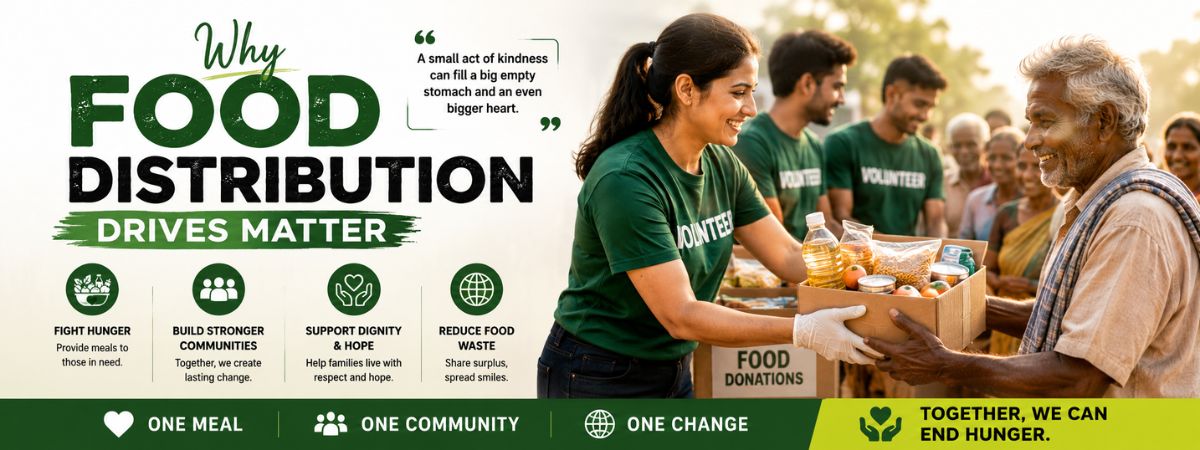
Hunger is often invisible, and in India, the face of food insecurity resides in urban slums, migrant worker camps, remote drought-stricken villages, and the homes of families whose daily wages have ceased.
About one-tenth of the world population suffers from food insecurity, according to the UN’s World Food Programme. India’s own State of Food Security and Nutrition report has for many years placed India high among the list of the most undernourished countries.
And that’s another thing that makes these drives important, even apart from the numbers: it helps to renew a community more deeply. There’s a shifting of how a community views itself when its residents come together to care for those with fewer resources. It’s not charity in the chilly sense, but neighbours looking out for their neighbours.
Across urban India, thousands of community kitchens and food drives emerged organically out of nowhere at the time of the 2020 pandemic. There was no government decree behind all that. There was an ordinary citizen’s realisation that a human being ahead needed food.
Who Can Organise a Food Distribution Drive?
Pretty much anyone with enough commitment and planning.
NGOs and charitable trusts: Organisations like Goonj and Robin Hood Army in India have scaled this up to year-round, city-wide food distribution. Such a model can be scaled up to any small size as well.
Schools and colleges: College-going students fit perfectly as runners. Many colleges, including those which have NCC units and NSS volunteers along with their social clubs, usually organise such drives on festive occasions or when exams get over.
Religious organisations: temples, mosques, churches, and gurudwaras have centuries of tradition in langar and community feeding. Their infrastructure and volunteer networks are often underused.
Companies through CSR: Indian Corporate Social Responsibility (CSR) legislation (Section 135 of the Companies Act) necessitates eligible businesses to incur expenditure on social welfare. Food distribution activities are the most commonly used and easiest of the qualifying CSR activities.
Resident Welfare Associations (RWAs): apartment communities and neighbourhood groups can run hyper-local drives targeting nearby construction sites, domestic worker communities, or elderly residents.
Individuals: a single motivated person can start a drive. It scales from there.
How to Plan a Successful Food Distribution Drive
Good intentions without planning lead to wasted food and frustrated volunteers. Here’s how to structure it properly.
Step 1: Identify who you’re feeding.
Before collecting anything, know your beneficiary group. Are you feeding daily wage workers? Children in an underserved school? Flood-affected families? Elderly people living alone? The answer determines what food you collect and how you distribute it.
Step 2: Set a collection target and timeline.
Work backwards. If you’re feeding 200 families, and each family needs a 5-kg ration bag, you need 1,000 kg of food. Set your collection drive to run 2 weeks before your distribution date; this gives you time to sort and package.
Step 3: Organise your donors.
They can be reached via a WhatsApp group, posts on social media (Facebook/Instagram), your office’s noticeboard or your local neighbourhood community. “Donate rice or dal” works better than “donate anything.”
Step 4: Set up collection points.
A college campus gate, a housing society lobby or a local grocery store that agrees to be a collection point can be good alternatives. Put the collection box in plain sight and man it at busy times.
Step 5: Sort, check, and package.
Do not distribute items until their expiry date has passed. Check that packets are still sealed. Build a simple assembly line with volunteers handling different items. Label each packet by contents.
Step 6: Plan the distribution.
Know the location, timing, and expected crowd size in advance. Coordinate with local administration or the community leader of the beneficiary area. Bring more than you think you’ll need.
Step 7: Document everything and Post on Social Media.
Report who you distribute to, what you distribute, and where you distribute. These are not going to be administrative paperwork but the stats that you want to build on what you’re doing; ultimately, these can show your donors what you’re doing. Promote this via social media so other people know and can get involved too!
What Foods Should Be Distributed?
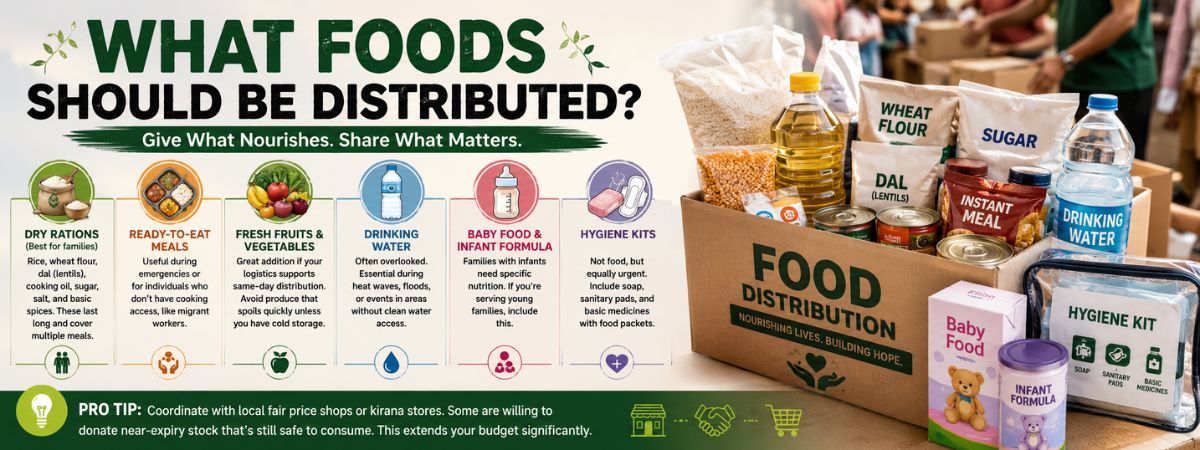
Not all food is equally useful. Here’s what actually helps:
Dry rations (best for families): Rice, wheat flour, dal (lentils), cooking oil, sugar, salt, and basic spices. These last long and cover multiple meals.
Ready-to-eat meals: Useful during emergencies or for individuals who don’t have cooking access, migrant workers on construction sites, for example.
Fresh fruits and vegetables: Great addition if your logistics supports same-day distribution. Avoid produce that spoils quickly unless you have cold storage.
Drinking water: Often overlooked. Essential during heat waves, floods, or events in areas without clean water access.
Baby food and infant formula: Families with infants need specific nutrition. If you’re serving young families, include this.
Hygiene kits: Not food, but equally urgent. A hygiene kit with soap, sanitary pads, and basic medicines alongside a food packet treats the person as a whole human being.
Pro tip: Coordinate with local fair price shops or kirana stores. Some are willing to donate near-expiry stock that’s still safe to consume. This extends your budget significantly.
Best Practices During Distribution
How you distribute matters as much as what you distribute.
Stay orderly by using markers on the ground and adequate signage. Crowd management at food drives can get chaotic without basic structure.
Respectfully handle recipients. Do not have photographs of anyone standing in line without their permission. Do not lecture or attach conditions to the delivery of food; simply hand it to them respectfully.
Maintain hygiene throughout: gloves for the handlers, covered food packets, no open dustbins near the venue for distribution.
Challenges Faced During Food Distribution
Anyone who’s run one of these drives will tell you the obstacles are real.
Logistics is the biggest one. Getting food from collection point to distribution point, especially in traffic or unfamiliar areas, takes more time and vehicles than you plan for.
Funding runs out faster than expected. Budget a 20% buffer for packaging, transport, and incidentals.
Food waste happens when you over-collect perishables or distribution is delayed. Stick to non-perishables unless your timeline is very tight.
Storage between collection and distribution can be a problem if you don’t have a cool, dry space. Coordinate with a local community centre, school, or place of worship that can lend space for a few days.
How Food Distribution Drives Benefit Communities
The ripple effects go far beyond a single meal.
For families: Just having food security for one week can relieve stress and allow adults to search for employment instead of just food. And children can go to school with an energetic spirit.
For children: A hungry child doesn’t learn effectively, drops out early, and fares demonstrably worse on all measures of health. Indian mid-day school meal schemes prove this on a national scale.
For elderly people: Among the most food-insecure, the most unrecognised are the senior citizens in India living in cities. One visit to a senior’s home can alter his/her life.
For volunteers: This part of food donation doesn’t get enough attention. Volunteers at food donations cite feelings of greater life satisfaction and more community bonding than non-donors, and they feel more connected to their purpose. It actually has benefits for the doer, not just the taker.
For local organisations: Running a credible food drive builds trust with the community, strengthens partnerships with donors, and creates a repeatable infrastructure for future humanitarian responses.
How Technology Is Improving Food Distribution
The old model – collect in boxes, count manually, load a truck, hope for the best is giving way to something far more efficient.
NGO apps and platforms like Feeding India (now part of Zomato) and No Food Waste allow real-time matching between food surplus and recipients. A restaurant with leftover food can be matched to a community kitchen in under an hour.
QR code systems are now used by some larger drives to track beneficiaries and prevent duplicate distributions. Each family gets a QR code; each distribution is logged digitally.
Donation platforms like Ketto, Milaap, and GiveIndia let drives raise funds online from supporters who can’t donate food directly. This has significantly expanded the funding base for small local drives.
GPS-based logistics help drivers find distribution points faster and help coordinators track vehicle locations in real time. Even basic tools like Google Maps’ “share location” feature help on distribution day.
WhatsApp-based inventory management simple, but effective for smaller drives. A coordinator creates a group, volunteers report their collections daily, and the number is updated in a shared Google Sheet. Nothing fancy needed.
Food Distribution Drives: You can start with
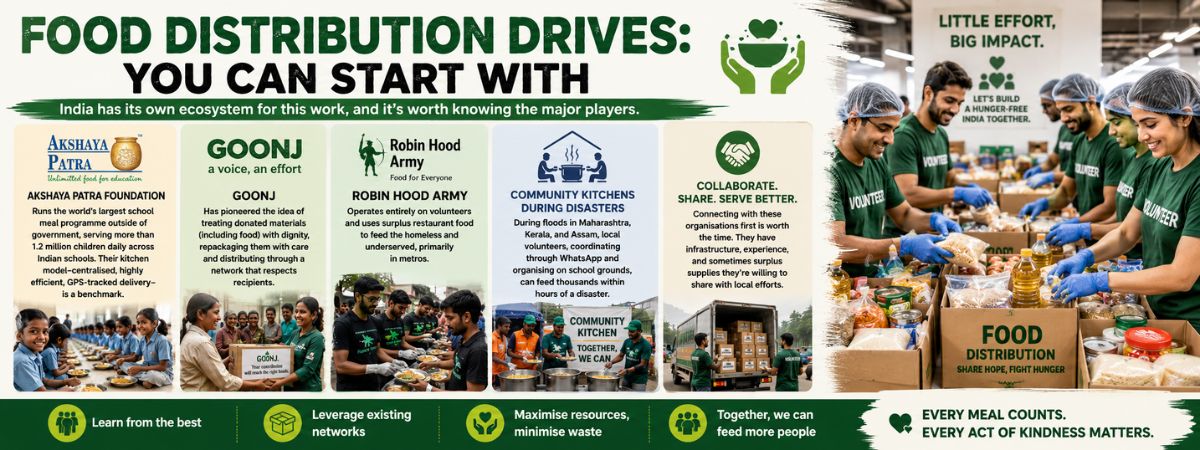
India has its own ecosystem for this work, and it’s worth knowing the major players.
Akshaya Patra Foundation runs the world’s largest school meal programme outside of government, serving more than 1.2 million children daily across Indian schools. Their kitchen model- centralised, highly efficient, GPS-tracked delivery is a benchmark.
Goonj has pioneered the idea of treating donated materials (including food) with dignity, repackaging them with care and distributing through a network that respects recipients.
Robin Hood Army operates entirely on volunteers and uses surplus restaurant food to feed the homeless and underserved, primarily in metros.
Community kitchens during floods in Maharashtra, Kerala, and Assam these states have repeatedly demonstrated that local volunteers, coordinating through WhatsApp and organising on school grounds, can feed thousands within hours of a disaster.
If you’re planning a drive, connecting with these organisations first is worth the time. They have infrastructure, experience, and sometimes surplus supplies they’re willing to share with local efforts.
Conclusion
Your food-distribution program doesn’t have to be complex in order to work. All it takes is somebody deciding to be the one to start, a picture of what that program looks like, and a group of people ready to play along. It’s rarely about having the money – it’s usually about who was the one to say, “Let’s make it happen.”
If you’re reading this as you get ready to take on your first driving trip, then: slow, steady and simple wins the day; take loads of photos and know that feeding 50 families food that they wouldn’t have had at home for days is no mean feat. Learn and go from there.
The hunger problem in India is large. The solution is many small, consistent, well-run efforts like the one you’re planning.
External References:
- World Food Programme — wfp.org
- Food and Agriculture Organisation (FAO) — fao.org/india
Frequently Asked Questions
What is a food distribution drive?
A food donation drive is a co-ordinated food collection campaign that is run by a group of people to get food supplies collected by donations and supplied directly to people who are experiencing hunger and lack food resources.
How do you organise a food distribution drive?
The very first thing you need to decide is exactly who you are feeding and how many people. You need to set your target collection quantity, organise the people donating the food, arrange your collection sites, prepare and pack the food, organise your distribution plan, and then record your collection. Most importantly is that you decide the distribution date of your collection first and work backwards on the collection time frame.
What food items are best for donation?
The most ideal non-perishable dry food items include rice, flour (atta), daal, cooking oil, salt and sugar. They can sustain a lot of meals, are convenient to transport and last long. Ready-to-eat meals are ideal during emergencies. However, fresh fruits and vegetables can only be useful if the day you collect them is the same day you distribute them.
What is the difference between food donation and food distribution?
Food donation is the act of giving food to a cause. Food distribution is the full process of getting that food from donors to the people who need it. Donation without proper distribution often leads to waste. A food distribution drive manages both ends of the chain.
Are food distribution drives tax-deductible in India?
Donations made to registered NGOs and charitable trusts that conduct food distribution drives may qualify for deductions under Section 80G of the Income Tax Act. The deduction amount (50% or 100% of the donated amount) depends on whether the NGO holds 80G certification. Individual volunteers organising their own drives should check with a tax advisor for applicable provisions.