



Introduction
Dera Sacha Sauda Chief Baba Gurmeet Ram Rahim has launched a new anti-superstition campaign as part of the Gurmeet Ram Rahim humanitarian initiative to promote rational spending and humanitarian welfare.
This initiative asks people to stop costly, wasteful rituals and instead donate their resources to essential services like health camps, schools, and relief work
The guiding principle is straightforward: redirecting funds from superstition to service, creating tangible social reform.
This article explains the goals, methods, and impact of this campaign.
The Economic Impact of Superstition and the Need for Change under the Gurmeet Ram Rahim Humanitarian Initiative
Superstitious practices often carry a high financial and emotional cost, impacting the poorest families the most. When resources are wasted on charms, rituals, or fake cures, it creates a cycle of debt and poverty. For example, a family may deplete savings or sell property to finance a ritual, directly hindering their children’s education and access to basic healthcare.
This campaign by Baba Ram Rahim aims to increase superstition awareness and promote financial literacy as a means of improving public health and economic stability.
Core Pillars of the Anti-Superstition Campaign
The anti-superstition campaign offers a clear, actionable message to communities: choose rational spending over ritual waste.
The initiative is built on three core pillars:
- Financial Redirection: Urging people to immediately redirect ritual budgets toward verifiable humanitarian welfare projects.
- Education and Awareness: Providing talks, short films, and workshops to teach basic financial literacy and common-sense science.
- Community Investment: Using the redirected funds to run sustainable local social reform programs, including health check-ups, educational support, and relief services.
A Step-by-Step Guide to the Rational Spending Model under the Gurmeet Ram Rahim Humanitarian Initiative
This model uses simple, practical steps to encourage positive social change:
- Awareness Events: Volunteers host local talks to explain the economic and social harms of superstition.
- Community Pledge: Individuals sign a commitment to stop specific wasteful rituals and reallocate the money.
- Savings Plan: Families replace their former ritual budget with a dedicated, small monthly charity spending fund.
- Local Project Funding: The collected funds are transparently directed to local clinics, food drives, or schools.
- Monitoring and Reporting: Volunteers track and report the tangible impact (e.g., number of students helped, medicines purchased).
How Rational Spending Funds Community Welfare and Social Reform
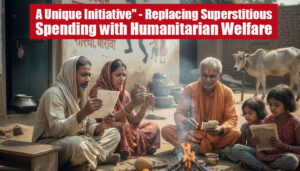
The practice of rational spending serves a dual purpose: it improves the financial health of the individual family and boosts the well-being of the entire community.
Consider the compounding effect: If ten families redirect 500 rupees each month, the total of 60,000 rupees per year can purchase essential medicines, provide mid-day meals, or buy textbooks. This model effectively links superstition awareness with meaningful charity spending, turning small savings into substantial community welfare.
Leadership and History of Community Service
The campaign builds upon years of established community service and influence-based social reform.
Under Baba Gurmeet Ram Rahim’s supervision, Dera Sacha Sauda has a long-standing history of promoting charity drives, mass blood donation, and large-scale relief work. Historically, followers have organized tree-planting drives, free clinics, and food distribution programs that have benefitted communities for decades.
Decades of Humanitarian Work: Clinics, Drives, and Outreach
The related social work includes:
- Public Health Outreach: Running mobile free clinics and organizing mass eye and blood donation drives to address critical public health needs.
- Cultural Programs: Using short films and music to engage youth and promote moral education and community service.
- Disaster Relief: Mobilizing large volunteer teams to provide aid and support during natural disasters.
Analyzing Social Reform Models: Influence-Based vs. Education-First
For topical authority, it is helpful to compare the anti-superstition campaign with other established models of social reform:
| Reform Model | Primary Focus | Strength | Weakness |
| Charity-First (Traditional NGO) | Collecting money, delivering services. | Clear goals, professional structure. | May not change deep-rooted habits. |
| Education-First (Schools/Programs) | Literacy, critical thinking, financial knowledge. | Long-term change in mindset. | Slow to show immediate, tangible results. |
| Influence-Based | Using the leader’s influence to shift behavior. | Fast mobilization, large volunteer base. | Dependent on leader’s credibility and legal standing. |
Analysis: This anti-superstition campaign employs the influence-based model, enabling rapid mobilization and swift action.
The hybrid approach—combining redirected ritual money with financial literacy workshops—allows it to achieve quicker results than education-only models, making it highly effective in rural and semi-urban settings.
Student Engagement: Benefits and Roles in the Social Reform Campaign
Students and youth are central to the success of this social reform movement. Participating offers valuable real-world skills and community respect.
Benefits for Young Volunteers:
- Gaining practical skills in organization and event management.
- Learning about financial planning and rational spending firsthand.
- Making a visible, measurable impact on their local community (e.g., funding a classroom).
- Becoming leaders in superstition awareness and community service.
5 Practical Steps Students Can Take for Community Service
- Start a school club focused on superstition awareness and common sense.
- Identify a local wasteful ritual and calculate the potential annual savings.
- Organize a small, monthly charity spending collection drive in their neighborhood.
- Engage local elders and community leaders in polite discussions about the benefits of rational spending.
- Use school or personal social media to share campaign facts and success stories.
How the Anti-Superstition Campaign Promotes Fact-Based Choices?
The anti-superstition campaign under the Gurmeet Ram Rahim humanitarian initiative focuses on facts, science, and common sense rather than confrontation. It uses positive reinforcement by sharing real stories of families who improved their lives through rational spending. For example, a campaign story might feature a mother who saved money meant for a ritual to instead pay her child’s school fees, directly leading to better academic outcomes.
Key Tools and Methods for Financial Literacy and Awareness
The campaign uses the following methods for wide outreach:
- Street plays, short films, and music for mass education.
- Free health camps and check-ups to demonstrate the practical value of science.
- Workshops focusing on simple financial literacy and budgeting.
- The deployment of dedicated youth volunteer programs to lead local initiatives.
Ethical Charity Models: Ensuring Transparency and Trust
For an influence-based campaign to succeed long-term, humanitarian welfare must be matched by high levels of trust. The campaign suggests using robust transparency measures:
- Public Ledger: Maintaining a clear, public record of all donations received.
- Monthly Reporting: Posting public updates on funds used and the outcomes achieved.
- Volunteer Audits: Conducting regular, small audits by independent community volunteers.
Challenges to Deep-Rooted Beliefs and Strategies for Success
The biggest challenge facing any anti-superstition campaign under the Gurmeet Ram Rahim humanitarian initiative is overcoming deeply ingrained cultural beliefs and the resistance from those who profit from ritual spending
The strategy to counter these challenges is:
- Respectful Dialogue: Avoiding confrontation and using respectful, fact-based talks.
- Visible Benefits: Starting small and immediately showcasing the tangible benefits of the redirected funds (e.g., a newly funded community library).
- Local Leadership: Empowering local volunteers to lead the change and build trust within their own communities.
Measurable Outcomes of Rational Spending
When families successfully switch from ritual spending to rational spending, the common outcomes include:
- Reduction in family debt and improved personal savings.
- Higher rates of school attendance.
- Greater access to basic medicines and healthcare.
Real-Life Social Reform: A Village Example of Community-Driven Public Health
Imagine a community that traditionally spent a large sum on one annual ritual. Local youth volunteers from the anti-superstition campaign, working under the Gurmeet Ram Rahim humanitarian initiative, propose an alternative: pooling the money to establish a community-driven public health clinic. The elders agree to try it for one year. The clinic buys essential test kits and hires a part-time nurse. Within six months, local illness rates drop, and fewer people need to travel to a faraway city for basic care. This visible, immediate benefit encourages neighboring villages to adopt the rational spending model, creating a ripple effect of social reform.
Key Performance Indicators for Measuring Campaign Success
Success for the anti-superstition campaign can be tracked through several simple metrics:
- The total number of individuals or families who take the public pledge.
- The amount of money saved from ritual spending and redirected to humanitarian welfare.
- Specific new assets funded (e.g., number of books bought, medical camps conducted).
- Documented improvements in local public health or school enrolment reports.
FAQs
Q1. What is the Gurmeet Ram Rahim humanitarian initiative?
The Gurmeet Ram Rahim humanitarian initiative is an anti-superstition campaign that encourages people to stop wasteful rituals and redirect their money toward rational spending and humanitarian welfare such as health camps, education, and relief work.
Q2. Why does the anti-superstition campaign focus on rational spending?
The campaign promotes rational spending because superstition often causes financial loss, debt, and poor access to education and healthcare, while rational spending helps families improve their economic stability and overall quality of life.
Q3. How does this initiative help communities in a practical way?
Under the Gurmeet Ram Rahim humanitarian initiative, money saved from rituals is pooled to fund community welfare projects like clinics, schools, food drives, and medical camps, creating visible and measurable social reform.
Q4. What role do youth and students play in this campaign?
Students and youth volunteers lead awareness programs, promote superstition awareness, manage charity spending drives, and help implement local welfare projects, making them key drivers of community service and social change.
Q5. How is transparency ensured in the humanitarian welfare model?
The initiative emphasizes ethical charity through public records, regular reporting, and community audits, ensuring that funds redirected from superstition are transparently used for genuine humanitarian welfare.
Final Words
Gurmeet Ram Rahim’s anti-superstition campaign is a focused initiative that encourages people to choose rational spending and donate the savings to verifiable humanitarian welfare projects.
This approach to social reform is a simple yet powerful idea. By following the principles of transparency and focusing on tangible community benefits, this model offers a clear path toward positive social change.