Yamaha has officially launched the Aerox E in India on July 8, 2026, at an introductory price of Rs 2,81,600 ex-showroom (Bengaluru).
That’s the kind of money that makes it the most expensive electric scooter that’s currently on sale in India – quite a bit more expensive than even the TVS X. It looks racy, is decently spec’d, and has the same pretty good design that the petrol Aerox 155 had. Is it worth the extra money you’d spend over its competitors? Read on to find out.
Price and Availability
| Detail | Information |
| Ex-showroom Price | Rs 2,81,600 (Bengaluru) / Rs 2,82,000 (Delhi) |
| Booking Amount | Rs 2,000 (Yamaha official website) |
| Available Cities | Delhi, Mumbai, Pune, Chennai, Bengaluru |
| Dealerships | Blue Square showrooms only |
| Colour Option | White (single option at launch) |
The Aerox E is currently available only at Yamaha’s premium Blue Square dealerships in five cities. A wider rollout to other cities has not been confirmed yet.
(Sources: BikeAdvice — Click here to more about this | AutoguideIndia — Check out here
Battery, Range and Charging
The Aerox E’s most distinctive feature is its twin removable battery system.
- Two 1.5 kWh lithium-ion packs = 3.0 kWh combined capacity
- Each pack: 30Ah, weighs around 8 kg (easily removable and carriable)
- IDC certified range: 117 km on both batteries fully charged
- Each battery charges in 3 hours 10 minutes (0-100%)
- Both batteries together: 6 hours 20 minutes for a full charge
- Home charging supported — compact charger stores in the under-seat cavity
- Battery warranty: 3 years or 30,000 km
- Riders can operate the scooter on a single battery while the second charges separately.
The easiest solution for apartment dwellers and city commuters lacking a dedicated parking and charging bay: just pull the packs out, charge them inside your home and slide them back into the vehicle.
A word of caution, though. While 117 km IDC sounds promising, a real-world scenario, especially during traffic conditions and with the AC on during a hot Indian summer, should result in a range of about 85-95 km with the batteries fully charged.
Performance: What the Motor Actually Does
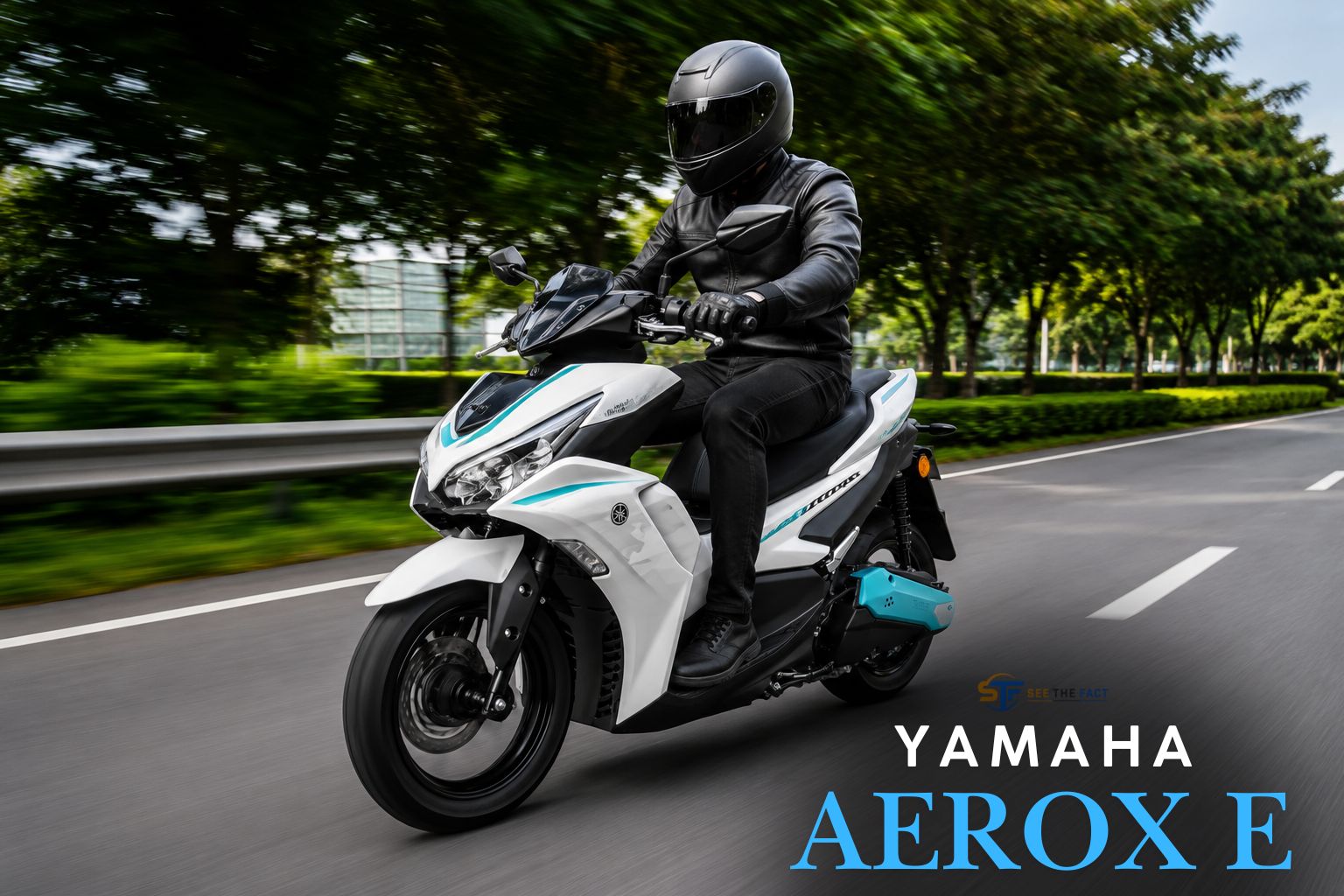
A permanent magnet synchronous motor powers the EV to the tune of a peak power of 9.4kW (12.6bhp) and 48Nm of torque for a claimed top speed of 95.5 km/h.
It is this torque number that sticks out – the petrol-powered Aerox 155 manages about 13.9Nm, and the electric variant offers more than three times that number.
Riding modes:
- Eco — conservative output, maximum range
- Standard — balanced everyday use
- Power — full motor output for overtakes and flowing traffic
- Boost — activated via a dedicated handlebar toggle. Provides maximum performance in short bursts. 10-second activation limit with a mandatory 30-second cooldown before use again
There is one particular limitation of this Boost mode to keep in mind. The 10-second power burst and required 30-second wait period sort of reduces the fun of the electric powertrain; it’s helpful for an overtake, but there’s nothing else you can do with it.
A reverse mode is also included for tight parking manoeuvres.
Features You Get at Rs 2.81 Lakh
Technology:
- 5-inch TFT colour display with turn-by-turn navigation
- Y-Connect smartphone app (last parked location, diagnostics, maintenance reminders)
- SmartKey keyless ignition
- USB-C charging port
Safety:
- Dual disc brakes (front and rear)
- Single-channel ABS
- Traction control system
Lighting:
- Dual LED Class-D headlights
- LED flashers
- 3D-effect LED taillight
Design:
- X Centre Motif (Yamaha’s signature)
- Spine-mounted charging port
- Under-seat cavity for charger storage
Storage: Under-seat space is compromised, with a 15-litre capacity in the Aerox E compared to the petrol-fuelled Aerox’s 24.5-litre boot. You can say goodbye to carrying a full-face helmet here; carry a backpack instead.
Aerox E vs Petrol Aerox 155: How They Compare
| Category | Aerox E | Aerox 155 |
| Price | Rs 2.81 lakh | Rs 1.44 lakh |
| Power | 9.4 kW / 48 Nm | ~11 kW / 13.9 Nm |
| Top Speed | 95.5 km/h | ~130+ km/h |
| Range / Tank | 117 km (IDC) | ~55-60 km per litre |
| Weight | 139 kg | 126 kg |
| Under-seat | 15 litres | 24.5 litres |
| Running Cost | ~Rs 0.5-0.8/km | ~Rs 4-5/km |
| Noise | Near-silent | Audible exhaust |
The running cost advantage is real and long-term. The practicality trade-off (storage, weight, range anxiety on longer rides) is also real and worth accepting consciously.
How It Stacks Up Against Rivals
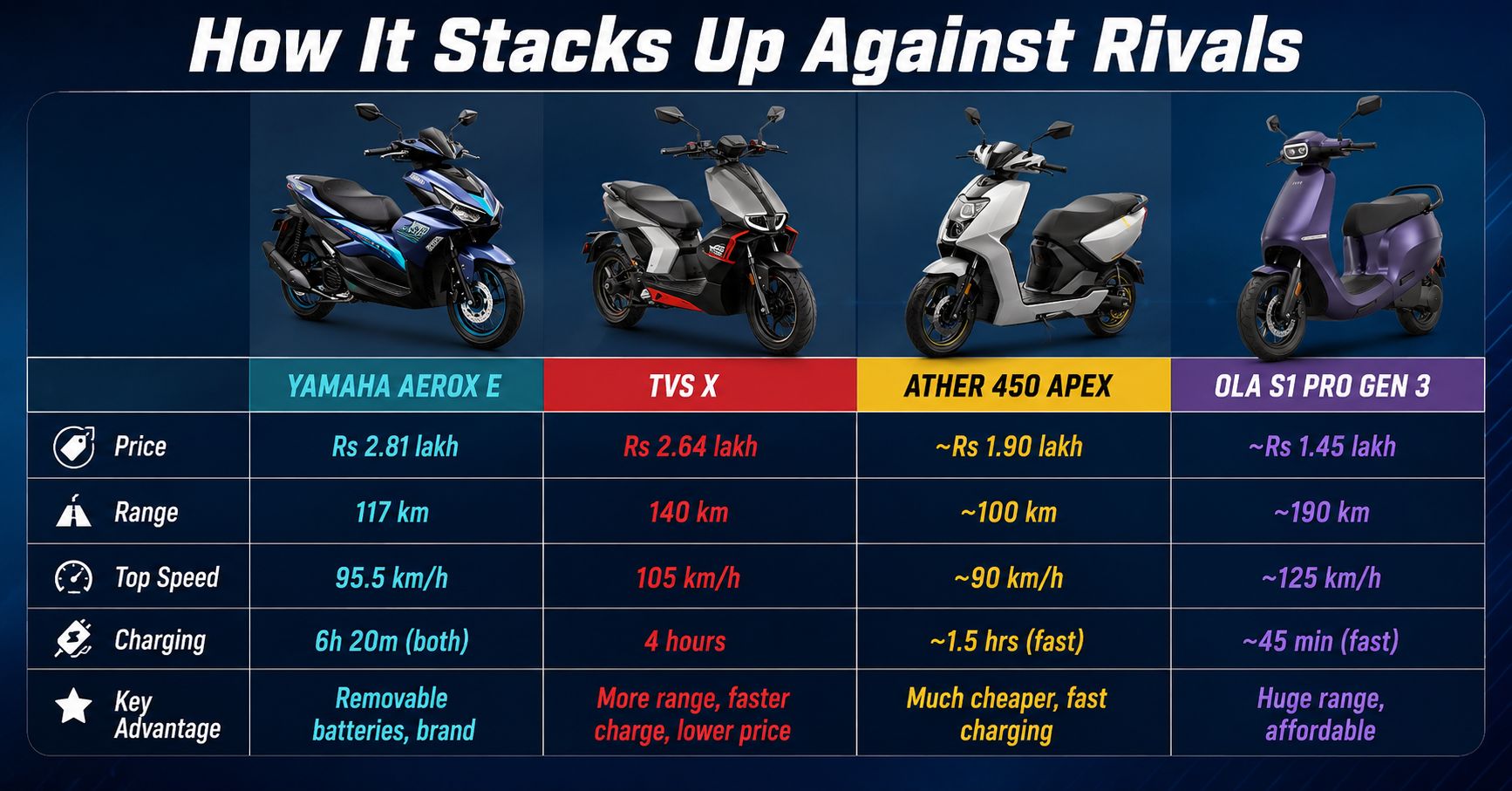
| Phone | Price | Range | Top Speed | Charging | Key Advantage |
| Yamaha Aerox E | Rs 2.81 lakh | 117 km | 95.5 km/h | 6h 20m (both) | Removable batteries, brand |
| TVS X | Rs 2.64 lakh | 140 km | 105 km/h | 4 hours | More range, faster charge, lower price |
| Ather 450 Apex | ~Rs 1.90 lakh | ~100 km | ~90 km/h | ~1.5 hrs (fast) | Much cheaper, fast charging |
| Ola S1 Pro Gen 3 | ~Rs 1.45 lakh | ~190 km | ~125 km/h | ~45 min (fast) | Huge range, affordable |
This makes the TVS X the most obvious and direct competitor. Coming at Rs 2.64 lakh, the TVS X offers 105 km/h top speed, 140 km range, and 4 hours charging time. At Rs 17,000 cheaper than the Yamaha, TVS’s e-scooter boasts of better range, top speed, and faster charging. The Aerox E comes with swappable batteries as a positive point, along with Yamaha’s riding dynamics and build quality.
The Ather 450 Apex is another game, quite considerably more affordable and comes with fast charging the Aerox E lacks. If range fear or charging rate matters more than either the Yamaha’s acceleration or the Ather’s sporty chassis, Ather wins the battle by an enormous gap.
(Source: BikeWale spec comparison — check here
Is Rs 2.81 Lakh Justified?
Honestly, that depends on the buyer.
What you’re paying for:
- Removable twin battery system that solves the apartment-charging problem
- Yamaha’s build quality, suspension tuning, and brand equity
- A maxi-scooter design that looks unlike anything else in the segment
- The most torque-rich ride in its price band (48 Nm)
What you’re giving up vs competitors:
- Range — TVS X goes 140 km; Ola S1 Pro Gen 3 goes 190 km
- Charging speed — no fast charging on the Aerox E
- Colour options — only white at launch
- Under-seat storage — 15 litres is genuinely limiting
Should You Buy the Yamaha Aerox E?
Buy it if you:
- Live in an apartment without a fixed EV charging point (removable batteries solve this)
- Ride primarily in the city and 117 km is enough for your daily commute
- Value Yamaha’s brand, build quality, and sporty ergonomics
- Want a distinctive design that doesn’t look like every other scooter on the road
Skip it if you:
- Need longer range for occasional highway or touring use
- Want fast charging — the 6-hour full charge is slow by 2026 standards
- Are comparing on pure value — TVS X covers more ground for less money
- Need under-seat storage for a helmet
Final Verdict
The Yamaha Aerox E is an accomplished premium electric scooter. Its only real differentiator is its removable battery system, and frankly, it solves a major issue for inner-city dwellers. Performance is decent, the feature set is strong, and the design is unmistakably Aerox.
However, at Rs 2.81 lakh, the buyer should ask a pertinent question: is this purchase made due to pure Yamaha affection, wanting the ability to remove the battery at will, and it becomes worthwhile. Or is it a purchase based on specs per rupee, then TVS X and Ather 450 Apex have more strong points.
Aerox E is the most expensive electric scooter in India; it deserves to be considered, but shouldn’t automatically jump to the top of everyone’s shopping list.