The talks in Doha just wrapped up. Both sides called it “positive progress,” agreed to keep talking, and then packed up and went home to wait.
Wait for what? For Ayatollah Ali Khamenei’s funeral.
Qatar’s Foreign Ministry spokesperson Majed al-Ansari confirmed on July 2 that the next US-Iran meeting will be scheduled “at the earliest possible time” after funeral processions for Iran’s former Supreme Leader, who was killed in an Israeli airstrike on February 28, the opening day of the US-Israeli war against Iran. Those ceremonies are spread across multiple cities in Iran and Iraq from July 4 through July 9, with a final burial in Mashhad.
So the world waits a week. And the question of the Strait of Hormuz, through which 20% of the world’s seaborne oil passes, remains open but unresolved.
What happened at the Doha talks? On July 2, US and Iranian negotiators held separate indirect talks in Qatar, mediated by Qatari and Pakistani officials. Steve Witkoff, the US Mideast envoy, and Jared Kushner represented the American side. Iran’s chief negotiator Kazem Gharibabadi led their delegation. Qatar said the discussions built on a previous high-level summit in Switzerland and on the Islamabad Memorandum of Understanding. Both sides agreed to continue. The next meeting date is pending the end of Khamenei’s funeral period.
(Source: NPR — https://www.npr.org/2026/07/02/nx-s1-5878887/us-iran-meetings-qatar | Times of Israel — https://www.timesofisrael.com/liveblog_entry/us-iran-made-progress-at-doha-talks-agree-to-regroup-after-khamenei-funeral-qatar/)
Why Is the Next Qatar Meeting So Important?
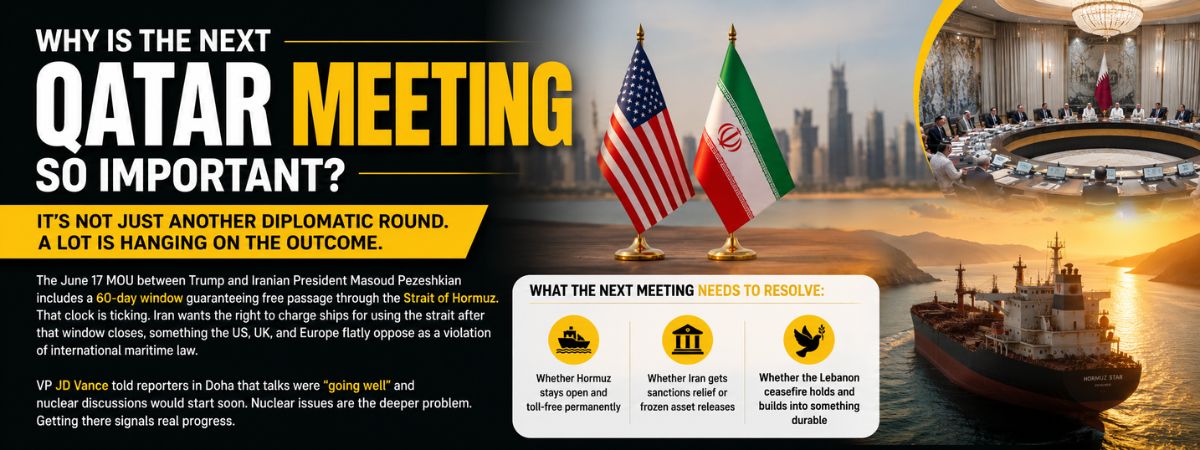
It’s not just another diplomatic round. A lot is hanging on the outcome.
The June 17 MOU between Trump and Iranian President Masoud Pezeshkian includes a 60-day window guaranteeing free passage through the Strait of Hormuz. That clock is ticking. Iran wants the right to charge ships for using the strait after that window closes, something the US, UK, and Europe flatly oppose as a violation of international maritime law.
VP JD Vance told reporters in Doha that talks were “going well” and nuclear discussions would start soon. Nuclear issues are the deeper problem. Getting there signals real progress.
What the next meeting needs to resolve:
- Whether Hormuz stays open and toll-free permanently
- Whether Iran gets sanctions relief or frozen asset releases
- Whether the Lebanon ceasefire holds and builds into something durable
(Source: CNN — https://www.cnn.com/2026/07/01/world/live-news/iran-war-trump | The Tribune — https://www.tribuneindia.com/news/usa-news/iran-oman-advance-plans-for-strait-of-hormuz-transit-fees-despite-us-opposition-report/amp/)
If the Agreement Happens, What Could Change?
1. Oil Prices Could Stay Stable
Markets have already begun responding to the positive signals from Doha. Oil prices have come down from the peaks seen during the worst of the Hormuz crisis, when OPEC output dropped more than 30% from pre-war levels, and the IEA called it “the largest supply disruption in the history of the global oil market.” A successful agreement locking in open passage would cement that relief.
2. The Strait Could Fully Reopen
At least 35 commercial vessels transited the Hormuz on June 30, according to MarineTraffic data. That’s a big change from the near-standstill earlier in the year. But full normalisation, with proper insurance available, seafarers willing to make the journey, and no toll pressure – needs a permanent deal, not just a 60-day pause. Right now, Saudi Arabia and the UAE are running their overland pipelines at full capacity to route around the problem. That’s not a permanent fix.
3. Iran May Get Economic Relief
Iran has pushed for the release of its funds held overseas and partial lifting of sanctions. Foreign media, meanwhile, have claimed that the frozen funds are also part of Islamabad’s MOU. How far the nuclear talks move beyond that is what will govern whether or not that turns into an actual release.
4. Regional Tensions Could Cool
A durable deal would take pressure off Lebanon, where a ceasefire brokered by the US, Qatar, and Iran remains fragile. Iranian Foreign Minister Abbas Araghchi warned on July 1 that any Israeli attack would trigger an “immediate powerful response”, a reminder that even with talks underway, the fuse is short.
(Source: Brookings — https://www.brookings.edu/articles/from-chokepoint-to-crisis-the-strait-of-hormuz-and-global-oil-markets/ | CNN — https://www.cnn.com/2026/06/30/world/live-news/iran-war-trump)
What If the Talks Fail?
This is the question nobody wants to say out loud, but it’s the one everyone’s thinking.
1. Hormuz Crisis Returns
Iran hasn’t mellowed much on shipping fees. The 10-point peace proposal reportedly gives the right to ships to be charged for passing through as reconstruction funds. According to legal experts from Sorbonne and the British Institute of International Law, this would breach a guarantee of innocent passage under the UN Convention on the Law of the Sea. However, Iran has not ratified UNCLOS, and it understands the leverage that it possesses.
2. Oil Prices Spike Again
Roughly 20% of the seaborne oil traded globally passed through Hormuz, along with a substantial proportion of Qatar’s LNG exports before the conflict. Then when that blows, the prices don’t just rise; they shoot. The East-West pipeline (Saudi Arabia) and the Habshan-Fujairah pipeline in the UAE can provide near-maximum capacity alternatives, cumulatively not enough to displace normal levels of Hormuz traffic.
3. Military Risk Returns and Supply Chains Get Hit
They include naval mine laying, tanker attacks, and drone strikes on vessels, all of which occurred earlier this year. Conservatives from inside the ruling establishment, including newly appointed supreme leader Mojtaba Khamenei himself, remain under pressure to criticise the talks. These are not theoretical; they have yet made their way into the prices of any country that relies on Gulf energy flows, with shipping delays, increased freight insurance and swarm-style volatility in global energy markets.
(Source: Wikipedia, 2026 Strait of Hormuz crisis — https://en.wikipedia.org/wiki/2026_Strait_of_Hormuz_crisis | PBS NewsHour — https://www.pbs.org/newshour/world/irans-proposal-to-collect-tolls-in-the-strait-of-hormuz-violates-trade-norms)
What Could This Mean for India?
India doesn’t have a seat at this table, but it has a very large stake in what comes out of it.
1. Petrol and Diesel Prices
India imports a very large share of its crude oil requirements. Persian Gulf suppliers, including Iraq, Saudi Arabia, and the UAE, are central to that supply chain, and all of them route exports through the Strait of Hormuz. When the strait tightened earlier this year, crude prices spiked, and the pressure on domestic fuel pricing was real. A new disruption hits India directly at the pump.
2. Inflation and Shipping Costs Rise Together
Higher transport costs don’t stay in the fuel sector. Aviation fuel, road freight, fertiliser prices, food supply chains. They all move with energy costs. Indian exporters using Middle East routes face higher freight rates and insurance premiums on top of that. Textile and auto component manufacturers with tight logistics margins feel this fast.
3. Energy Security and Exports Under Pressure
The earlier crisis pushed India to consider strategic reserves and alternative suppliers more seriously. A fresh breakdown brings all that back, and faster. It also affects Indian exports to Europe or Africa routed near the Gulf, adding rerouting costs and delivery delays on top of higher energy bills.
(Source: Brookings — https://www.brookings.edu/articles/from-chokepoint-to-crisis-the-strait-of-hormuz-and-global-oil-markets/)
The Question Nobody Can Answer Yet
Can Qatar’s next meeting prevent another Strait of Hormuz crisis, or is the world only getting a temporary pause?
Right now, the honest answer is: nobody knows. The 60-day free passage window from the June 17 MOU is the only thing keeping traffic moving without a toll fight. Both sides are still far apart on the Hormuz governance question. Iran wants revenue. The US won’t accept a toll system. Oman is caught in the middle, having submitted a voluntary fee proposal that Iran calls mandatory and the US calls unacceptable.
Vance says it’s going well. Araghchi is issuing warnings about Israeli strikes. Both of those things are true at the same time, this week.
Bottom Line
The next round of US-Iran talks in Qatar, whenever it happens after July 9, may genuinely be the most consequential diplomatic meeting since the June 17 ceasefire. A real agreement could stabilise oil markets, restore full Hormuz shipping, and give Iran some economic breathing room.
But if it fails, or if the toll dispute can’t be resolved before the 60-day MOU window closes, the disruption comes back. And it won’t stay in the Middle East. Oil prices, inflation, freight costs, and energy security concerns will reach every country that buys energy from the Persian Gulf.
India is at the top of that list.
Will the Qatar talks hold? Drop your view in the comments.
The timing around the funeral is an important detail because it shows how political events can delay diplomacy even whenUS-Iran Talks Analysis both sides describe the talks as productive. I also think it will be worth watching how shipping insurers and energy markets react during this pause, since expectations alone can influence oil prices before anything changes in the Strait of Hormuz.