As soon as Attorney General R. Venkataramani uttered these words in the Supreme Court, ‘Ethanol blending experiment‘ started trending somehow. The government-run E20 programme is still experimental and will reveal its true results only after 2027 itself. A tough line for a policy already in operation at every petrol pump across the nation. This gave vehicle owners who’d been complaining of sharper drops in mileage and engine problems something to hang their hats on: even the government is saying it’s not entirely sure yet.
Quick answer: The 20% ethanol blending programme (E20) is still an experimental exercise and its impact will be clearer only in 2027, the Centre told the Supreme Court during hearings in an ethanol-allocation dispute with BPCL. This is not a rollback because the government has separately reiterated that it will not change the 20% blending policy. The comment did not call for pausing or rolling back the programme. Instead, it urged the government to measure its long-term impact.
What Did the Government Tell the Supreme Court?
This observation arose from a case filed before the Supreme Court by Bharat Petroleum Corporation Limited (BPCL), which challenged an order of the Karnataka High Court regarding the allocation of ethanol for the supply year 2025-26. Representing the Centre, Venkataramani told the bench that authorities finalised ethanol supply contracts for this cycle in October 2025. He added that reopening those contracts now would disrupt the nationwide ethanol blending programme.
Venkataramani also pointed out that identical petitions were pending in several High Courts and requested the Supreme Court to club them into a single case before October 2026, when authorities will review the next round of contracts. Such an approach, he argued, would prevent lengthy litigation across multiple courts. That is essentially what this hearing was: to arbitrate a jurisdictional mess between BPCL and the Karnataka HC. The “experiment” comment was almost a side note that ended up becoming the headline.
Did the Government Really Call Ethanol Blending an Experiment?
What the Court Actually Said
Yes, and it’s on record. Venkataramani told the bench that the government still considers the push for 20% ethanol blending an ongoing test and expects tangible results in about a year. Several outlets, including Outlook and India Today, reported his remarks. NeoGAF first highlighted the “next year” timeline, while later reports focused on a more specific 2027 date.
The Government’s Clarification
Hours after the hearing, Venkataramani told India Today TV that the government would continue the 20% ethanol blending policy. He explained that authorities may increase or decrease ethanol quotas for individual companies based on supply and demand. However, those adjustments will not affect the national E20 policy.
Why the Confusion Started
Many people found the word “experiment” confusing because India already sells E20 fuel nationwide. However, the government used the term in a narrower sense. It continues to collect real-world data on long-term engine performance, emissions, and farmers’ income. While the E20 blending target remains fixed, policymakers continue to evaluate its long-term impact.
What Is the E20 Ethanol Blending Programme?
India produces ethanol mainly from sugarcane, while maize and surplus rice also contribute to production. E10 fuel contains 90% petrol and 10% ethanol, whereas E20 increases ethanol content to 20%.
India reached its E20 target in 2025, five years ahead of the original 2030 deadline. Since April 1, 2025, oil marketing companies have supplied E20 fuel across the country. The government has also set a 30% blending target for 2030 and removed excise duty on higher ethanol blends such as E22, E25, E27, and E30 to accelerate the transition.
Why Did India Start Ethanol Blending?
- Reduce oil imports: India imports more than 85% of its crude oil. According to government data, ethanol blending has replaced an estimated 245 lakh metric tonnes of crude oil.
- Support farmers: Ethanol procurement gives sugarcane, maize, and rice farmers a reliable market for surplus crops.
- Improve energy security: Ethanol reduces India’s dependence on volatile global oil markets.
- Lower emissions: Ethanol burns more cleanly and increases octane levels, helping vehicles meet BS-VI emission standards.
What Are the Concerns Around E20 Fuel?
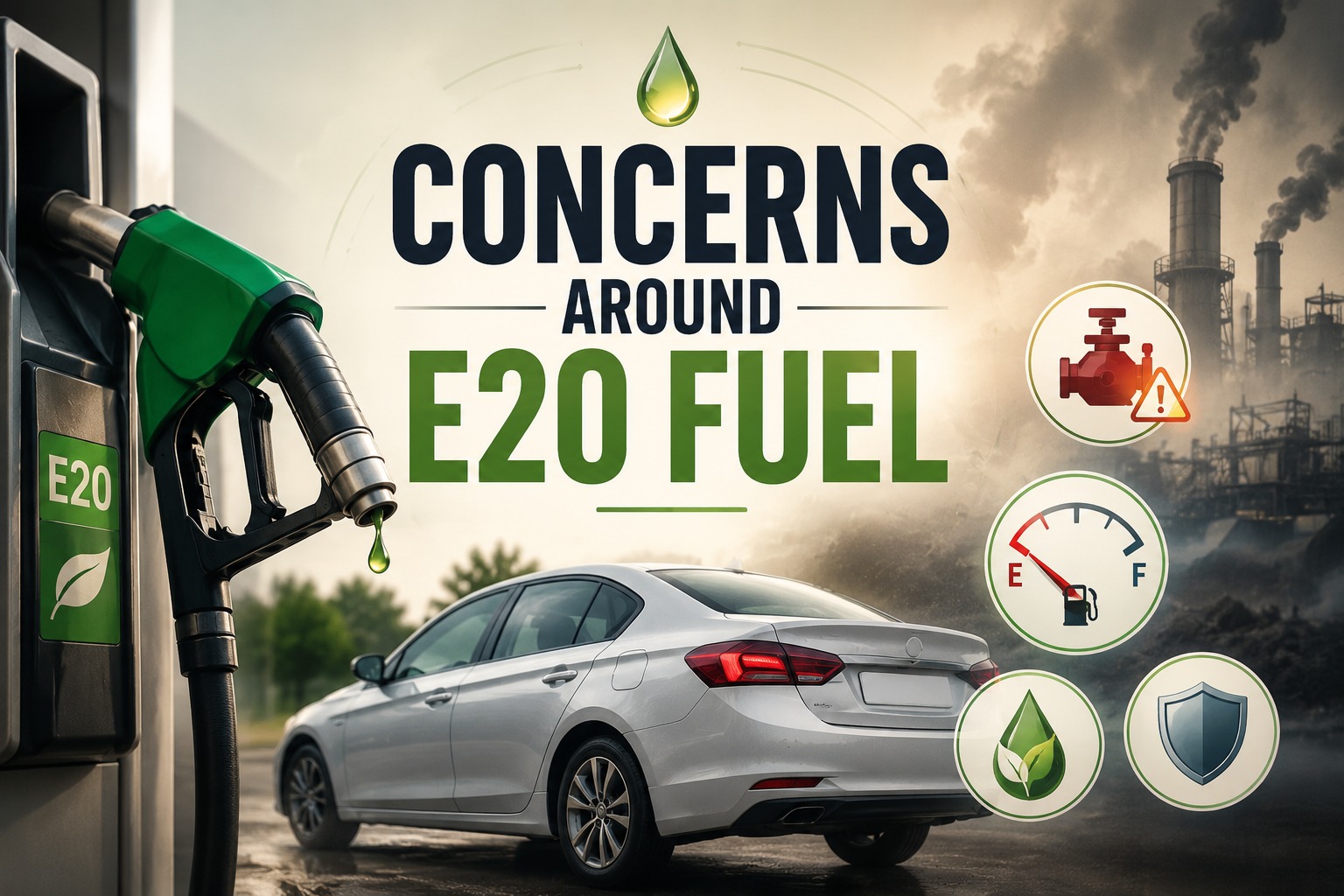
Owners of vehicles manufactured before 2023 have raised the strongest concerns because manufacturers did not design many of those vehicles for E20 fuel. In a LocalCircles survey of about 36,000 vehicle owners, nearly 94% opposed the nationwide rollout of E20. Another survey found that about 28% of owners who switched older vehicles to E20 noticed unusual wear or needed additional repairs.
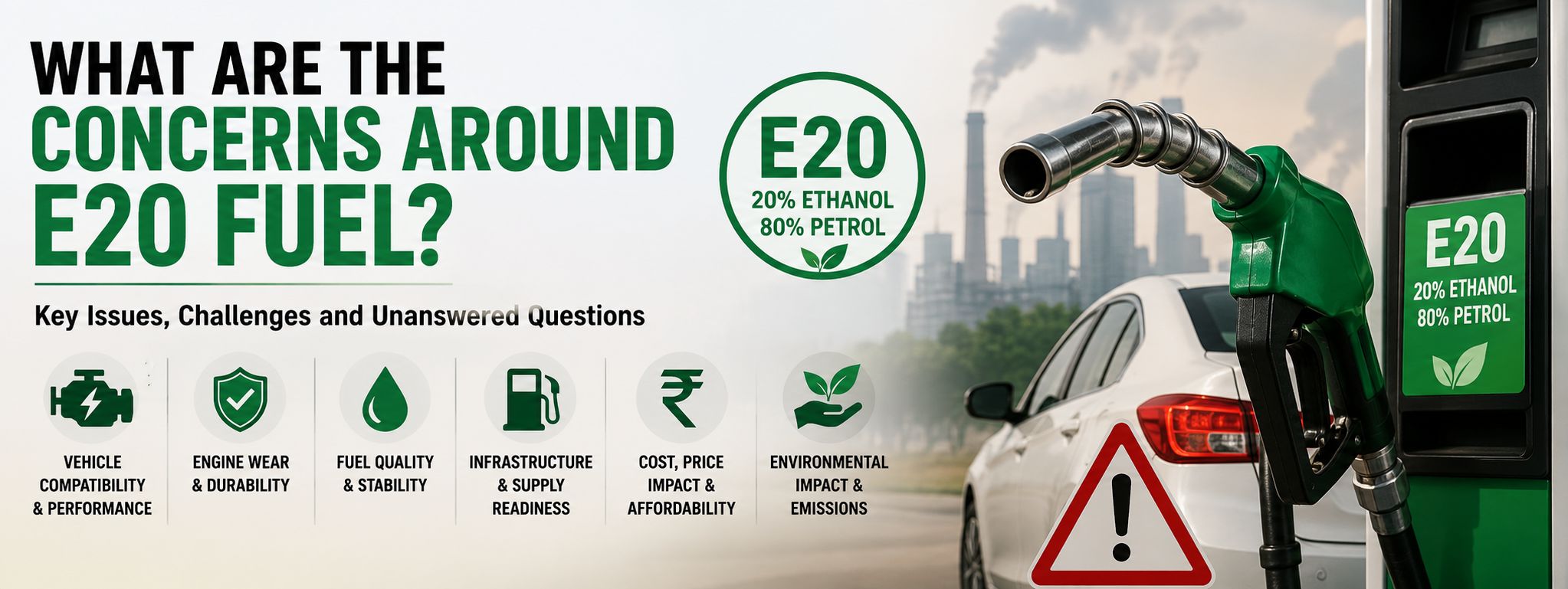
Ethanol can gradually degrade older rubber seals, hoses, and gaskets. Drivers have also reported reduced fuel economy, rough idling, difficult cold starts, and clogged fuel filters.
The Ministry of Petroleum and Natural Gas rejected claims that E20 causes severe mileage losses. According to the ministry, E20 reduces fuel economy by about 1–2% in vehicles manufactured after 2006 and by up to 6% in older vehicles. The ministry also said that regular maintenance keeps most vehicles within acceptable limits.
Can Ethanol Damage Vehicles?
Pro tip: Check your owner’s manual or fuel cap for an E20 compatibility label before using E20 fuel. Manufacturers such as Maruti Suzuki and Hyundai have already published compatibility lists.
What Happens If the Experiment Fails?
Many people on social media have asked this question. However, current evidence does not show that E20 has failed. Although the Centre told the Supreme Court that it continues to study the programme’s long-term impact, it has not concluded that E20 causes widespread problems.
The Ministry of Road Transport and Highways has not introduced any compensation programme for engine damage linked to E20. Likewise, insurers do not treat E20 use alone as a reason to deny motor insurance claims. If you own an older vehicle, follow the manufacturer’s maintenance schedule instead of expecting the government to reverse its E20 policy.
Frequently Asked Questions
Is ethanol blending an experiment?
Partly. The government has finalized the 20% blending policy but continues to collect data on its long-term impact. It expects clearer findings by 2027.
What is E20 fuel?
E20 fuel combines petrol with 20% ethanol. Fuel stations across India have sold it since 2025.
Can E20 fuel damage vehicles?
Most newer BS6 vehicles can use E20 without major issues. Older vehicles may experience faster wear on rubber fuel-system components and greater mileage loss.
Conclusion
E20 is here to stay. The government has made it clear that it will continue the 20% ethanol blending policy. However, it is still studying how E20 affects vehicles already on Indian roads over the long term. If you drive a vehicle built before 2023, check its E20 compatibility, follow the recommended maintenance schedule, and watch for the government’s 2027 impact assessment.